Saturday, 10 January 2015

From Rump To Rafters - Day 3

A Traditional Family Adventure With Mamma and Co.
sausages made simple salami making with sara grazia
For the past 2 days I've  been busy breaking down a 200kg pig for the production of homemade sausages, salami and an array of cured meats. We've been to the farm, deboned the carcass, salted the meats, mixed recipes and now today we start producing.
Day 3 is salami making day! This is always an exciting part of the process. This year we’re making 7 different types of salami. Usually we would only do a couple of variations, mamma's recipe – that has remained the same ever since I can remember. Over the years I've tried adding a change or two and every time I've been beaten away with a wooden spoon, so I learnt its best not to mess with a tried and tested formula.
Having a few extra kilograms of meat available this year however, I've managed to mix up some wonderful recipes I would not normally have the opportunity to do. I’ve made some favorites from my Secrets in Salami Book – Molisano, Calabrese, Felino and the Finnochina. I was also thrilled to be able to mix a couple of batches from a recipe a dear Italian friend had given me on my last visit. One particular mix would shock any salami making traditionalist, however I was fortunate enough to try a sample he had made on my last visit and it was to die for.
My other surprise recipe looks like a fairly typical mix on paper, however the trick with this recipe is the type of meat used and how it’s prepared and processed. As I have mentioned previously, the differences between the varieties of salami is not just in the spice mix – it’s so much more.
sausages made simple salami making with sara grazia sausages made simple salami making with sara grazia sausages made simple salami making with sara grazia
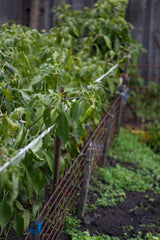
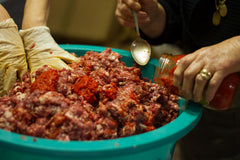
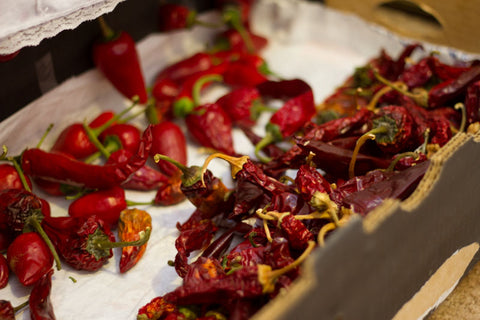
You've probably read something where I've mentioned my mamma's authentic handmade pepper sauce and how we use it quite regularly in our mixes. I’d like to introduce you to her crop of piping hot chili’s. Every year she harvests these little gems, some are dried and crushed, while others are squeezed and turned into paste.
sausages made simple salami making with sara grazia
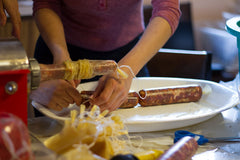
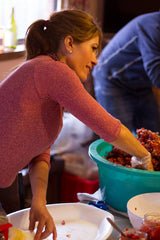
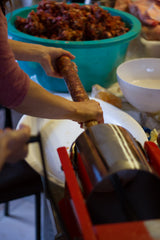
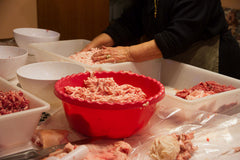
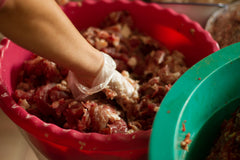
We start the day by filling some casings with the salami mix we had prepared the day before. I’m starting with the Calabrese recipe while on the other side of the table they’re filling the Felino. 
sausages made simple salami making with sara grazia sausages made simple salami making with sara grazia
Depending on who you invite over to help you on your salami making event, it’s best to keep a close eye on what’s happening around you, more specifically an eye on your recipe mixes. A friend of mine has a particular need to constantly want to add something ’extra’ to each and every recipe if not watched closely. Mammas wooden spoon comes in handy on these moments!
With one of my new recipes that I’m trying, more ingredients need to be added after the main body of the meat mix has rested overnight. This will intensify the aromatic qualities and flavour of the finished product. This particular recipe has taken my salami making to new level of excitement.
sausages made simple salami making with sara grazia
sausages made simple salami making with sara grazia sausages made simple salami making with sara grazia
One of my favorite parts of the salami making process is cooking up a small batch of the mix and nibbling away on it with some homemade crusty bread and a little Italian coffee. As this is a meat mix for salami making the salt content is considerably higher than that of a fresh sausage mix, because it’s needed for the curing process. Eating the mix with lovely fresh crusty bread helps dampen down much of the saltiness and you get to enjoy the flavours.
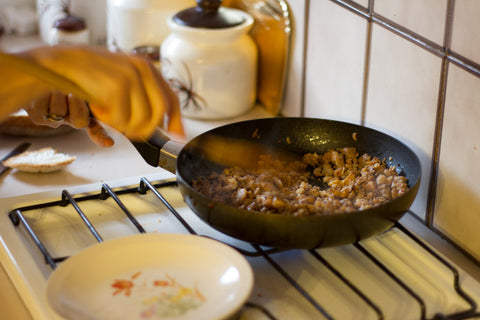
sausages made simple salami making with sara grazia
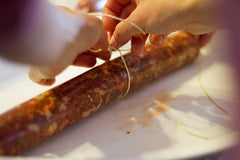
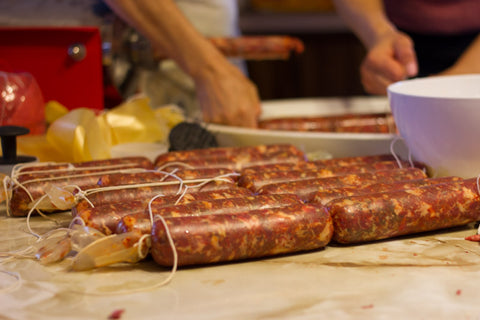
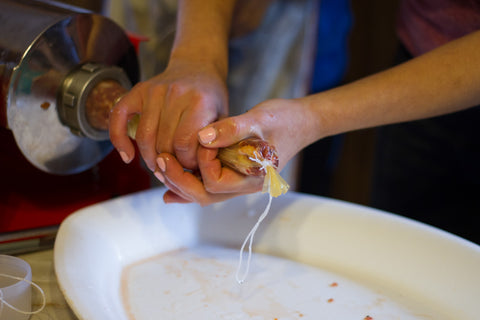
After a short break, it’s back to filling and tying. There is more than 80kg of meat that needs to be filled and its moments like these that you’re grateful for the help of family and friends. 
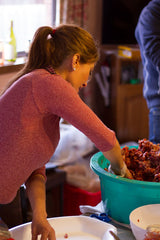
sausages made simple salami making with sara grazia sausages made simple salami making with sara grazia sausages made simple salami making with sara grazia
For those a little reluctant to get out of bed for an early Sunday morning start – the bribe of my mamma’s home cooked breakfast lunch and dinner always seems to be a good motivator. There’s a little bit of morning grumbling, but that soon passes after biscuits and coffee has been handed out. 
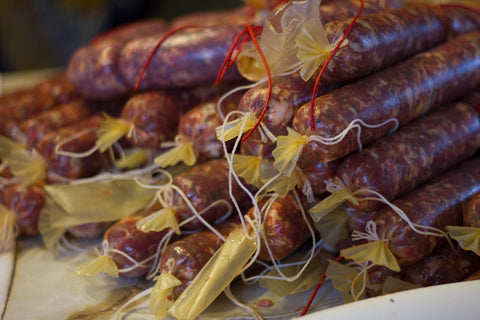
sausages made simple salami making with sara grazia
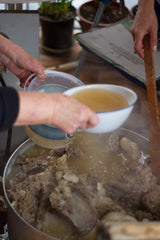
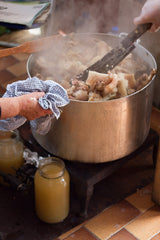
While we’re all busy filling casings and netting the salami, mamma is boiling up more bones preparing the lardo…..and lunch.
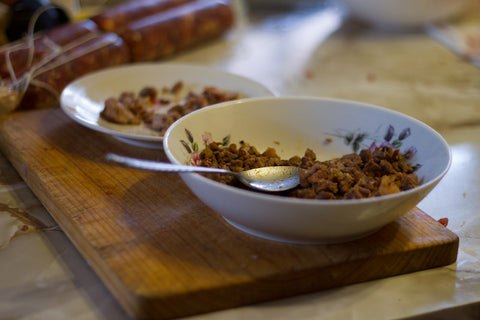
sausages made simple salami making with sara grazia
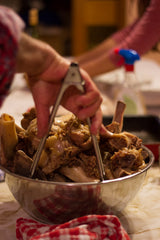
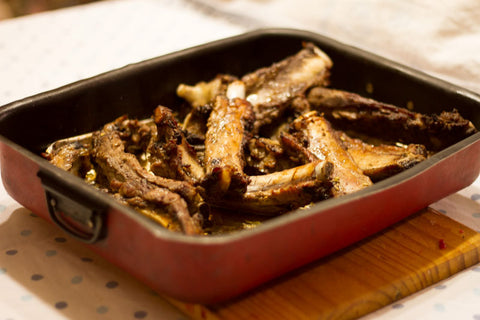
The bones are boiled for hours to the point where the meat is only just hanging on by the teeniest morsel. It’s tender and lean and falls apart on your tongue, most importantly of all though, it’s delicious. The bones are served up as is and you enjoy the meat right of the bone, nothing added – no sauce and no spices. As the bones are boiled the natural fats and marrow flavour the meat. The liquid left in the pot is drained, filtered and poured into jars. Natural, preservative free lardo.
sausages made simple salami making with sara grazia sausages made simple salami making with sara grazia sausages made simple salami making with sara grazia
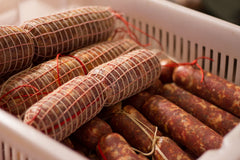
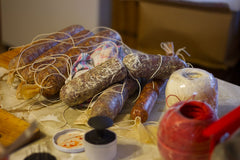
After a late lunch, it was time to get back onto the salami making, our batch was rapidly increasing with two fillers on the go. We all had a little job to do and between shifts we kept topped up on coffee, biscuits, bread and grappa! It was what I imagine an artisan production line to be like. Around this massive table some of us were preparing casings, others tying the casings when full and then there were those netting the salami. Once the salami were all finished, they were put into a container and left in the garage to rest before they are hung the day after.
sausages made simple salami making with sara grazia sausages made simple salami making with sara grazia
Before I left for the day, I went to check on my cured meats which were coming along wonderfully. I drained the brine, added a little more salt and left them to rest for another night, excited about processing them all tomorrow.
sausages made simple salami making with sara grazia
If you've missed out on how my journey started, take a look at what we got up to on Day 1 and Day 2. This is Day 3 down and I'm looking forward to an early night before finishing off all the cured meats in the morning.

From Rump to Rafters - Day 2

A Traditional Family Adventure With Mamma and Co.
sausages-made-simple-sara-grazia
We're hearing about it everywhere at the moment, restaurants are offering it, top chefs are embracing it and everyone loves it – Nose to Tail, Paddock to Plate – name it what you like but this process is nothing new. From since I can remember my family has always processed food this way.
It’s Day 2 of my traditional salami making and meat curing weekend. It wasn't quite the early start as it was the day before. This morning the sun is out and there’s a cool breeze – all in all the perfect weather for de-boning my pig and processing a pig.
It's never an easy job de-boning an entire pig on your own, especially one that weighs 4 times what you do… It was going to be a long and exhausting day, but something I look forward too every year! By the time I got to my mammas, there was coffee brewing on the stove and homemade lemon biscuits fresh out the oven.
Before the others arrived we had our coffee, nibbled on hot biscuits then got to work laying the table, sharpening the knives, preparing the spices and washing a number of buckets ready for the various cuts of meat to be put into. The meats would be allocated to each bucket by purpose and would be used for making the salami, fresh sausages, cured meats and lardo.
sausages-made-simple-salami-making sausages-made-simple-salami-making
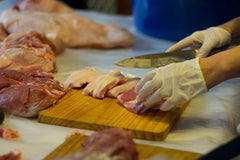
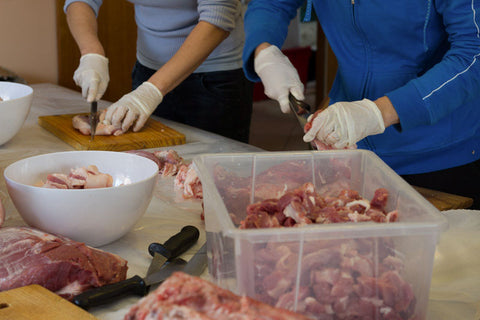
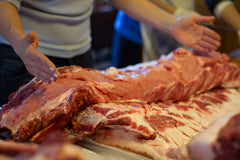
As the morning went on people slowly started to filter in and lending a hand. We started by laying out all the individual sections of the carcass on a long table. Mamma and co. were at one end, cleaning and dicing up the meat, getting it ready for mincing later on. 
sausages-made-simple-salami-making
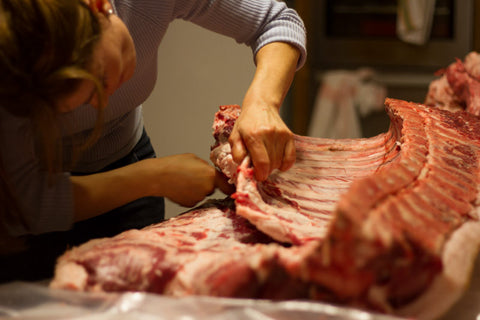
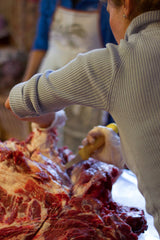
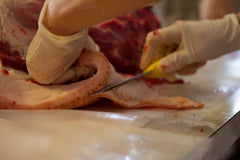
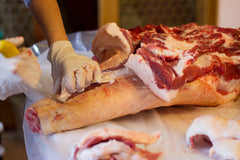
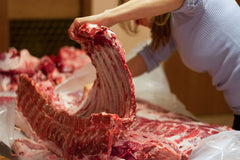
Down the other end of the table I was busy dividing fillets and carefully removing the ribs and spine to expose the cuts that would be used for the pancetta and lonza. All the quality cuts of meat went into one bucket ready for salting, while all the bones went into another ready for boiling… and dinner!.
sausages-made-simple-sara-grazia-de-boning sausages-made-simple-sara-grazia-de-boning 
Processing an entire pig isn't for everyone, its labour intensive and time consuming; however I find the process really exciting. Having studying anatomy back at university, seeing all the different sections of the animal and which cut of meat comes from where is wonderfully intoxicating to me. Being able to separate all the individual cuts properly is an art in itself, and the quality and precision of how the job is done is reflected in the finished product.
sausages-made-simple-sara-grazia-de-boning sausages-made-simple-sara-grazia-de-boning
Preparing the prosciutto is always one of the most challenging parts of the process. Many artisans would argue that prosciutto making is a masterful craft in itself. To produce a quality piece of prosciutto can take several years of practiced skill. This cut is the king (or in this case, the Queen) of all cured meats.
sausages-made-simple-sara-grazia-prosciutto
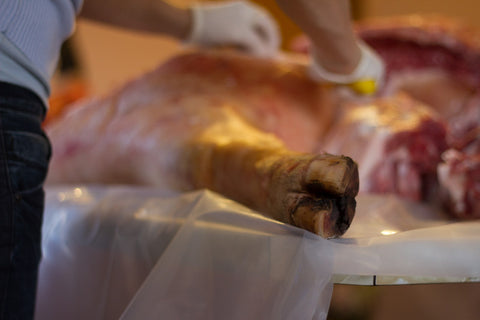
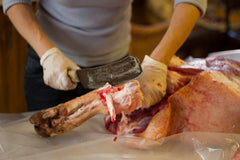
As I’m going to be preparing one leg for myself and the other for the family, mamma and I decide to keep one leg on the bone and the other will be dissected into individual sections and turned into prosciuttini. Having a 200kg animal tends to gives you more liberties on what and how much of everything you can process.
sausages-made-simple-sara-grazia-prosciutto sausages-made-simple-sara-grazia-prosciutto
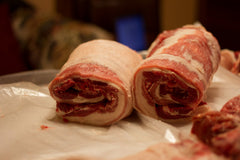
After the prosciutto was seen to, it was time to process the other half of the carcass starting with the pancetta. Once the ribs are removed, we cut them down into manageable sizes and they were taken off to the kitchen and slow roasted while we all continued working. After a short time the aroma of the seasoned oil Glaze my mamma had prepared for the ribs was heating up and it filled the air inside and out. At this point I started thinking "Tools down… DINNER!”. 
sausages-made-simple-sara-grazia-making-pancetta sausages-made-simple-sara-grazia-making-pancetta
In my previous post, I said that my parents would use the entire animal, and above I mentioned how popular the whole “Nose to Tail” processing is becoming. I wonder if they do actually use everything in all those fancy eateries that boast of such things!
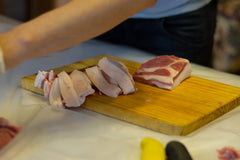
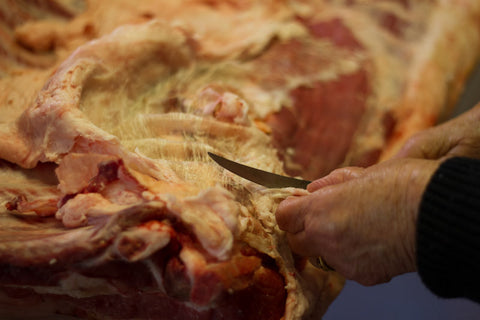
Here my mamma is meticulously removing a very thin fat layer from the belly. She then tenderly tears and pulls it apart into paper thin layers. This is what we're going to wrap our capocollo in later. Many of you that cure meats of your own probably use the dried version of this for wrapping your capocollo, pancetta, bresola and other meats in ready for curing. To see the difference in appearance, if you’re unfamiliar click here.
This is a real example of how everything within the animal is valued and used in the traditional sense. When I say everything is used, I mean it literally!
sausages-made-simple-sara-grazia-making-pancetta
After all the bones have been taken away to boil for hours in a massive 140 liter pot, the meats that would be used for curing are salted and set aside to rest. Now seems like a perfect time to sample those slow cooked ribs.
sausages-made-simple-sara-grazia-making-pancetta
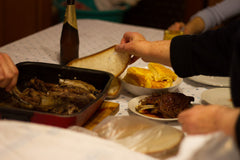
Along with crispy bread and an omelet that could feed an army, we all tucked into dinner. It was simple, delicious and comforting. For the first time all day everyone was silent! We all slumped down at the table and enjoyed.
After dinner, I lost quite a bit of my help, only a brave few of us were left to see the final phase of the day through to completion. It was time to tackle the salami.
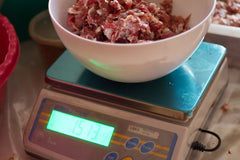
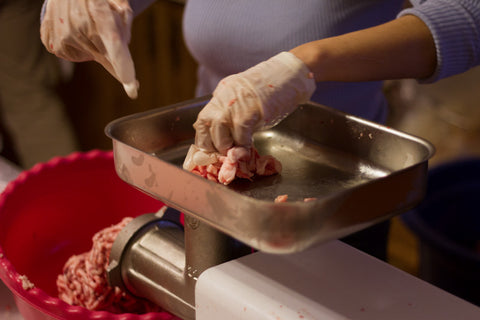
There was one bucket filled with lean meat, another with slithers of pork fat and another filled with beautifully marbled cubes of meat. These would all be used to make different types of salami. It’s not just the seasoning mix used that differentiates one salami from another. With the scales to the left and the meat mincer to the right, slithers of fat and lean meat were weighted up and put through the mincer.
sausages-made-simple-sara-grazia-salami-making
After mincing, the spices were added and mixed through. While one of us was furiously mixing, blending everything together, the other was putting the next lot of meat through the meat mincer. Spices were added and mixed through thoroughly. This process continued four or five more times until all the salami meat had been minced, mixed and put to one side to rest overnight before filling.
sausages-made-simple-sara-grazia-salami-making sausages-made-simple-sara-grazia-salami-making
It was now a little after 11:00pm and it's time to go home and sleep. There is still a lot of work to be done over the coming days.
If you missed reading about Day 1 click here and discover where the journey originally started.
If you want to try some new salami recipes of your own, see my Secrets in Salami book and make a variety of different types of salami that have been enjoyed for generations.

From Rump to Rafters - Day 1

A Traditional Family Adventure With Mamma and Co.
Every year, very early in the morning – I load up the car with all my salami making and meat curing supplies and equipment.
It’s 6am, dark and bitterly cold on a Friday morning, I’m all rugged up in my woolen beanie, coat and the thickest gloves I own and I’m off to go and collect a pig! Today is the first day of a 4 day salami making and meat curing adventure that me, mamma and co. undertake every year. This has been something we’ve always done ever since I can remember. Back when I was younger, my parents reared their own pigs on the family farm. They were fattened up all year ready for a winter slaughter, something my father got the entire family involved in (and half the neighborhood).I don’t rear my own pigs now, it can get a little difficult in a little inner city Victorian terrace so I rely on local farmers to do the rearing for me.
 
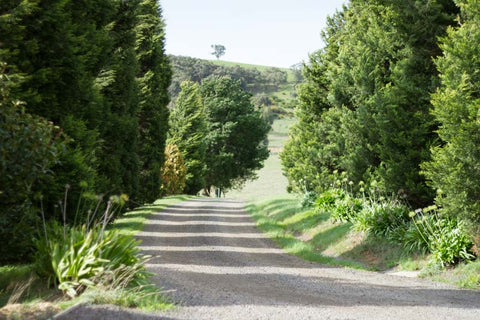
By the time we reached the farm, it’s been a little over an hour, the sun has risen to display the most spectacular scenery. Outside its freezing cold and blowing a gale, but the farmyard still looks picturesque as the sun breaks through the tree line.
 
It’s going to be a busy and labour intensive morning, there is a 200kg lady pig to slaughter, clean and hang ready for processing. I was given this beautiful white pig as a birthday gift and I’m hoping the meats I’m planning on producing are going to delicious. After seeing the size of the animal, all my fears are quickly vanquished. My mind is racing coming up with other uses for the excess meat I wasn’t expecting to have (I was expecting approx. 170-180kg)
After the pig had been killed it was taken up to the farmhouse to be cleaned. First things first, all the hair had to be removed from this massive animal. Processing an entire animal isn't for everyone, although it's a wonderful part of the traditional salami making and meat curing process. This is the point where you can gauge the quality of the produce you will be making. It will give you a good indication of the animal’s health and size. As my parents would often say "happy pigs make good meat and good meat makes tasty sausages".
 
It took the best part of 2 hours (maybe even longer) to get my 200kg carcass all shaved, washed down and hung. Once she was clean on the outside, it was time to get started on the inside. This is a delicate process and all the internal organs need to be carefully removed and (ideally) not damaged in any way. Keeping with tradition, nothing goes to waste. Everything is carefully and meticulously removed and put into buckets and soaked. The intestines are thoroughly cleaned and put aside ready to use later on. 
 
With the majority of the hard labour complete and the wind not losing any of it chill, it was time to get into the farm shed and have a little morning tea. At one end of the shed was a wonderful array of salami, prosciutto, capocollo and other meats hanging from the rafters. It was like being a child in a lolly shop. I walked up and down each row, squeezing and smelling the ones I thought ready to eat. It didn't take long before I found what we’d all be having for morning tea!
It was a spicy salami, Calabrian style - I took it town and over to the farmer and he put it through the slicer. There was also some homemade capocollo sliced up on the plate that he was very excited about us wanting to try. His excitement was not falsely represented, the meat was tender with a lovely blend of pepper and paprika.
 
Both the capocollo and the salami were laid out with homemade bread from the wood fire oven and wine. For those more game, there was grappa on the menu too. We all stood around a barrel of boiling water to keep nice and warm in the winter chill.
 
With our bellies full and fingers thawed, we sipped on Italian espresso before heading back into the wind to finish of preparing the carcass. The carcass was halved exposing a lovely thick layer of fat and really well marbled pink meat underneath. Signs of a healthy and happy pig.
Once halved it was much easier to see which parts would be used to make what. With the pig being so large, the amount of production practically doubled. The pancetta alone where half the size I am, and there are two! The capocollo looked they were going to weigh in at well over 4kg, which is quite a feat for only half a neck. There was a brief moment of panic quickly succumbed by joy. I’ve been holding onto a few new recipes I’ve been wanting to try since my last trip to Italy, and now with all this extra meat I’d be able to try out at least a couple of them.
Hanging from its hooks, the pig was over 71/2 feet long, there was no way it was going to fit into the van like that, so it was cut down a little more, we weight up each section, wrapped them tightly and then loaded the individual bits and pieces into the van.
  
It was time to say goodbye to the farmer and his wife and take the drive back towards town to hang the sections of meat at mammas overnight. It’s now time to rest up before another early start and the excitement of day 2. I’ll let you know how we got on on day 2 shortly, stay tuned.
If you’d rather not have to wait to find out what we’re up to in our blog posts, join us on twitter and google+ and see all the excitement live as it happens.